

Commentary
Is Morocco’s migration policy protecting Sub-Saharan African migrants or managing them for political and security ends? This article unpacks the gaps, the risks, and the paths toward real rights-based integration.
Soufiane Elgoumri
{
  "authors": [
    "Dalal A. Marafie"
  ],
  "type": "commentary",
  "blog": "Sada",
  "centerAffiliationAll": "dc",
  "centers": [
    "Carnegie Endowment for International Peace"
  ],
  "englishNewsletterAll": "menaTransitions",
  "nonEnglishNewsletterAll": "",
  "primaryCenter": "Carnegie Endowment for International Peace",
  "programAffiliation": "MEP",
  "programs": [
    "Middle East"
  ],
  "projects": [],
  "regions": [
    "Middle East",
    "Kuwait"
  ],
  "topics": [
    "Political Reform",
    "Economy"
  ]
}

Source: YASSER AL-ZAYYAT/AFP via Getty Images
Kuwait’s government has repeatedly launched ambitious reforms under Kuwait Vision 2035, yet bureaucratic inefficiency, siloed institutions, and weak feedback mechanisms continue to stall progress. Adopting government analytics—real-time monitoring and evidence-based decision-making—can transform reform from repetitive announcements into measurable outcomes.
Around the world, governments are under pressure to deliver more with fewer resources, respond faster to citizen needs, and build trust in public institutions. Kuwait is no exception. Despite waves of strategic and ambitious initiatives anchored in Kuwait Vision 2035, a visible push for modernization, digital transformation, and rule-of-law reforms, and extensive government and organizational restructuring, Kuwait's administrative system remains deeply inefficient. Decision-making processes have grown cumbersome, institutions such as ministries operate in silos, and reform agendas often repeat without measurable change or tangible progress. The private sector has grown weary and disillusioned: foreign investors hesitate and many local investors seek opportunities abroad.
In Kuwait, progress has been made from the Sahel e-government platform to ongoing process automation in key ministries; however, gaps remain. The pace of change in government procedures still lags behind the expectations of younger generations, whose standards for service delivery are shaped by global best practices. Closing this gap requires a coordinated approach where each entity plays its part, guided by a shared measurement and feedback system.
This article proposes that Government Analytics — a framework developed by the World Bank Group to systematize the use of administrative and survey data to strengthen public administration — offers Kuwait a path forward. Government analytics is not a luxury; it is a necessity if Kuwait hopes to translate its vision into action with measurable outcomes.
Kuwait doesn’t suffer from a lack of strategies. It suffers from a lack of sensors. Without real-time monitoring and evaluation mechanisms, institutions struggle to detect emerging issues early, respond effectively, and sustain reform momentum. Embedding robust government analytics can enhance agility, improve responsiveness, and ensure alignment with the long-term ambitions of Kuwait Vision 2035.
Reforms are not hypothetical. Under its Market Development Program, Kuwait has implemented significant capital market reforms aligned with Kuwait Vision 2035, such as introducing a central counterparty clearing framework, enhancing brokerage standards, and streamlining trading processes. These measures, including the adoption of sub-account numbering to strengthen transparency, are modernizing financial infrastructure, bolstering investor confidence, and attracting global capital inflows.
In Q1 2025, Kuwait issued 9,881 new business licenses — a 9.4% increase from last year. Most were personal company licenses (8,390), while special-purpose company licenses fell sharply to 38. Notably, freelance and micro-enterprise licenses surged 227% to 1,453, following August 2024 reforms that allowed 175 activities to operate without office requirements, processed through the Sahel and other digital platforms. These results show that removing procedural barriers and leveraging technology can rapidly boost economic participation.
Kuwait’s Ministry of Commerce and Industry has also introduced a policy allowing one office to hold up to five commercial licenses (with at least 50% shared ownership), streamlining setup and reducing fake office addresses. Applications are processed via the One-Stop Service Platform, with safeguards such as inspections and zoning compliance ensuring oversight. This shift reflects a recognition that regulatory flexibility, paired with oversight, can reduce friction for entrepreneurs without undermining compliance standards.
These changes are part of broader reform efforts already underway, driven by a visible push from leadership — most notably from the Amir of Kuwait, His Highness Sheikh Mishal Al-Ahmad Al-Jaber Al-Sabah — toward modernization, fiscal discipline, and digital transformation. Kuwait Vision 2035 and supporting institutions such as the Supreme Council for Planning and Development have laid critical groundwork for strategic change.
While the road to full implementation is long, the political will is not absent. This was underscored when His Highness met with the newly appointed Prime Minister and Cabinet, calling for a “new phase of reforms.” He urged the acceleration of strategic development, the enhancement of infrastructure, and the strengthening of healthcare and education systems — all anchored in transparency and the safeguarding of public funds. His vision extends to investing in human capital, fostering innovation, and advancing scientific research as the foundation of a resilient, knowledge-based economy. These are not mere aspirations; they are directives that require a governance framework capable of tracking, evaluating, and adapting reforms in real time — precisely where government analytics becomes indispensable. Yet, even with this momentum, sustaining progress will require confronting the deeper structural constraints that too often hinder reform.
A brief history of Kuwait’s planning state explains why these gaps persist. Following independence in 1961, Kuwait created one of the region’s earliest planning authorities, envisioning a modern, centrally coordinated state. Yet as oil revenues surged, the focus shifted from performance to patronage. Ambitious visions and structural plans were announced, but implementation repeatedly lagged. Institutional silos, weak feedback loops, and inconsistent political commitment meant that reforms often stalled before delivering results—a pattern documented in Walls Built on Sand: Migration, Exclusion, and Society in Kuwait.1 Without a system like government analytics to bridge these structural weaknesses, the cycle of aspiration without execution is likely to continue.
Despite reform announcements, the machinery of government often moves at a pace disconnected from the urgency of Kuwait’s economic and social needs. Initiatives may launch with fanfare but stall for months—or even years—due to fragmented decision-making, unclear mandates, and weak coordination across ministries. This is not simply a matter of political will. It is also an operational challenge. When reform plans lack a clear framework for measuring performance, tracking inter-agency dependencies, or resolving bottlenecks, even well-intentioned initiatives can falter.
From my own work with Kuwait’s public institutions, certain patterns repeatedly emerge—patterns that can be diagnosed as symptoms of bureaucratic paralysis:
These recurring challenges are not isolated—they are interconnected. The table below reframes them using a government analytics lens, mapping each problem area to its current state and its systemic consequences. This structured view makes it easier to identify where interventions are most urgent and to track whether reforms are delivering on their promises. This framework moves beyond anecdotal observations, breaking complex governance challenges into measurable components that make it easier to pinpoint urgent interventions and track progress over time.
|
Problem Area |
Current State |
Consequence |
|
Decision-making |
Opaque, slow, and often dependent on multiple unaligned approvals |
Lost investment opportunities; delays in service delivery |
|
Data use |
Data gathered but not analyzed or linked to decision-making |
No institutional learning; inability to adapt policies |
|
Institutional culture |
Risk-averse, resistant to innovation, reliant on informal influence |
Reform fatigue; protection of the status quo |
|
Coordination |
Fragmented, with overlapping mandates and weak accountability |
Redundancy, inefficiency, and resource waste |
Addressing these weaknesses requires more than ad-hoc fixes. Government analytics offers a disciplined approach: visibility into where reforms stand, which agencies are meeting their commitments, and where corrective action is needed. Without such a system, reforms risk becoming a repetitive cycle of announcements and partial execution—a pattern Kuwait cannot afford if it aims to achieve the ambitions of Kuwait Vision 2035.
Kuwait’s history shows that vision without execution creates cycles of stalled reforms. While strategic plans like Kuwait Vision 2035 set ambitious goals, they often lose momentum due to slow procedures, overlapping mandates, and wasta-driven decision-making. Government analytics provides a mechanism to break this pattern by embedding accountability, transparency, and evidence-based decision-making into every stage of reform.
By embedding clear performance metrics, inter-agency tracking, and early-warning systems for bottlenecks, analytics turns policy aspirations into measurable outcomes. Unlike traditional reporting—often static and backward-looking—analytics offers immediate insights, enabling leaders to act before delays escalate.
The model below reframes governance as a continuous, self-correcting process that draws on performance data and citizen feedback to drive reform. It integrates Kuwait Vision 2035 and United Nations Sustainable Development Goal (SDG) 16 (Peace, Justice, and Strong Institutions) into an actionable framework.
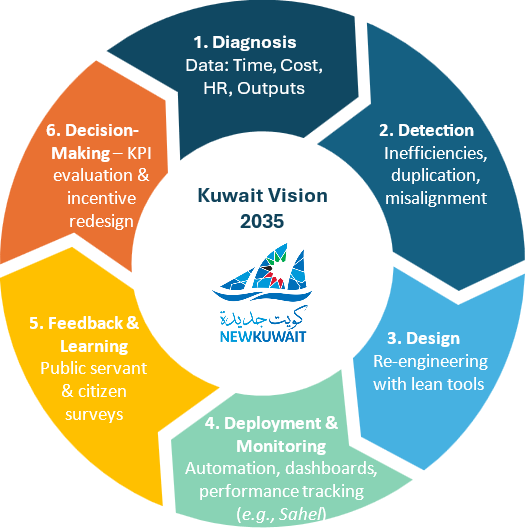
Six Stages of the Loop:
Continuous Loop:
This cycle repeats, ensuring reforms are institutionalized rather than treated as one-off interventions. Each iteration sharpens decision-making, reduces waste, and strengthens public trust. By adopting such a loop, Kuwait can shift from reactive reform to proactive governance—minimizing institutional waste at its root and ensuring that digitization is accompanied by genuine process improvement.
Institutional Preconditions for Analytics:
For the analytics loop to work, certain foundations must already be in place: data must be transparent and accessible across agencies, coordination mechanisms must be formalized to prevent overlap, civil servants must have the skills to interpret and act on insights, and leaders must be committed to evidence-based decisions. Without these basics, analytics risks becoming another reporting exercise rather than a driver of reform.
Government analytics is a structured approach to utilizing administrative, survey, and performance data to enhance the functioning of governments. The OECD defines it as the systematic use of data and analysis to inform decision-making and optimize policy delivery. At its core, it is about turning information into actionable insight — governments are more effective when they understand how they operate. Unlike mere data collection, government analytics links metrics to decision-making, accountability, and resource allocation
In Kuwait, this model is particularly relevant for achieving the ambitious of:
By embedding continuous feedback loops into policy and service delivery, government analytics can help Kuwait shift from a planning-centric to a learning-centric government — one that not only designs reforms but also adapts them instantly based on performance evidence.
As Steve Zagoudis notes in The Art of Lean Governance: Governance Metadata Management (2022), sustainable efficiency depends on managing governance “metadata”—the relationships between business, technical, and risk concerns—to uncover value and control risk. His approach, grounded in Goldratt’s Theory of Constraints, applies lean thinking from manufacturing to public-sector data, ensuring that reforms are targeted where constraints matter most.
At the heart of these challenges lies a complex web of procedural bottlenecks, overlapping mandates, and siloed data systems, which hinder coordinated action. The absence of a unified analytics framework and effective feedback mechanisms often results in agencies working in isolation, duplicating efforts, and delaying outcomes. Without mechanisms to monitor, analyze, and adapt operational systems, reforms lack timely evaluation, making it harder to address bottlenecks or adapt policies quickly. This fragmentation not only slows reform but also erodes public trust, as citizens and businesses face inconsistent service delivery and limited transparency in decision-making. Without the capacity to measure progress, identify gaps, and adapt strategies, even the most ambitious reform agendas risk devolving into repetitive cycles that produce little lasting impact.
For example, Kuwaiti entrepreneurs often face extended waits—sometimes stretching over many months—for routine business license approvals. These delays are less about specific policy barriers and more the result of entrenched procedural practices that lack transparency and timely feedback. Similar ventures in Dubai are often established within weeks, sometimes days, highlighting a stark difference in procedural efficiency (World Bank Doing Business 2020). While Kuwait is actively pursuing positive reforms, this real-world comparison underscores the urgent need to embed greater transparency, accountability, and data-driven monitoring into its governance framework. Other countries have tackled similar challenges through targeted, analytics-driven reforms, offering valuable lessons for Kuwait.
Drawing from these international success stories, Kuwait stands at a pivotal point. Embracing a Lean Governance Feedback Loop would align reforms with Kuwait Vision 2035 while ensuring each government entity plays its role in building a more agile, citizen-focused future. Global experience shows how analytically driven governance delivers measurable results:
Why it works:
These models cut processing times, boost transparency, and embed continuous improvement—whether in digital-first Estonia or service-driven Singapore. For Kuwait, the lesson is clear: government analytics is not optional but essential to close the gap between reform announcements and delivery.
These examples prove that aligning analytics, governance, and reform delivers measurable results. For Kuwait, the challenge is not possibility but execution — adapting these lessons to its own institutional realities. The following five-point agenda outlines practical steps to translate global best practices into local impact:
Kuwait’s path to efficiency requires more than digitization — it demands governance that learns, adapts, and improves continuously. This approach tracks how decisions are made, detects procedural waste, and re-engineers processes using data and citizen feedback, turning Kuwait Vision 2035’s ambitions into day-to-day operations.
Kuwait’s Lean Governance in Action (aligned with Kuwait Vision 2035 priorities):
When data becomes the organizing principle of governance, bureaucracy shifts from process-heavy to performance-driven — reducing waste, increasing transparency, and ensuring reforms endure.
Kuwait’s journey toward effective governance is not solely about digitization or modernization—it is about building systems that serve citizens today while preparing the next generation for a rapidly evolving world. Achieving this requires more than technology upgrades; it demands a fundamental shift in how procedures are designed, implemented, and measured across every government entity.
While initiatives such as Sahel and other e-government platforms have improved service delivery, gaps remain in aligning government implementation styles with the expectations and pace of the new generation. Bridging this gap requires embedding a culture of continuous improvement, where governance analytics is not an afterthought but a core decision-making tool.
Every government entity plays a critical role in this transformation. By systematically using analytics to monitor performance, identify bottlenecks, and adapt policies in real time, Kuwait can move from isolated successes to a coordinated reform movement. This approach not only accelerates the delivery of Kuwait Vision 2035’s aspirations but also ensures that reforms endure, adapt, and remain relevant for decades to come.
Dalal A. Marafie
Dalal A. Marafie is a highly accomplished professional with a strong academic background and extensive experience in private sector development, political economy, and gender equality. She holds a Master's degree in Middle East Studies, with a specialization in GCC Studies, from the University of Exeter in the United Kingdom. With over seven years of experience at the World Bank Group, Dalal has led and supported impactful development and advisory projects across the Middle East, particularly in Kuwait, Qatar, and Iraq.
Carnegie does not take institutional positions on public policy issues; the views represented herein are those of the author(s) and do not necessarily reflect the views of Carnegie, its staff, or its trustees.
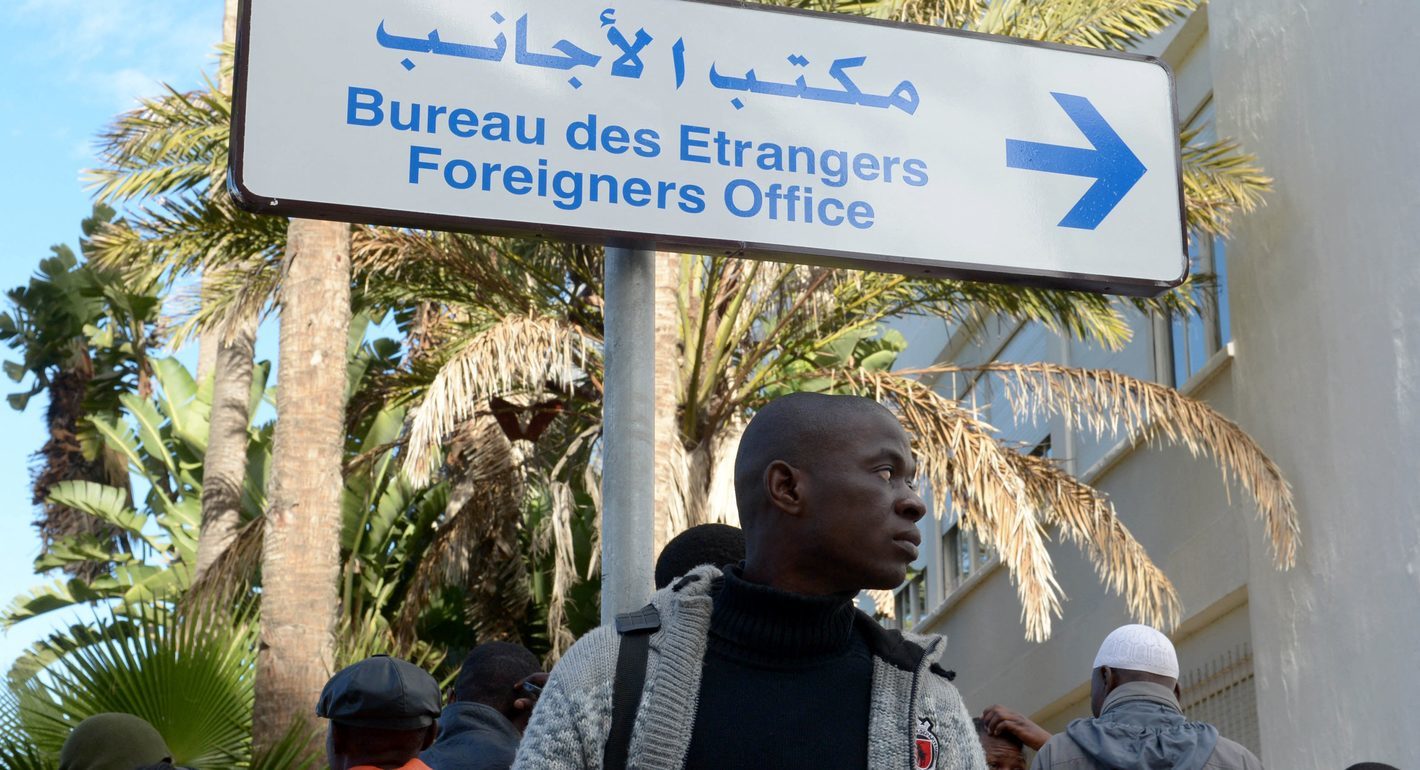
Is Morocco’s migration policy protecting Sub-Saharan African migrants or managing them for political and security ends? This article unpacks the gaps, the risks, and the paths toward real rights-based integration.
Soufiane Elgoumri
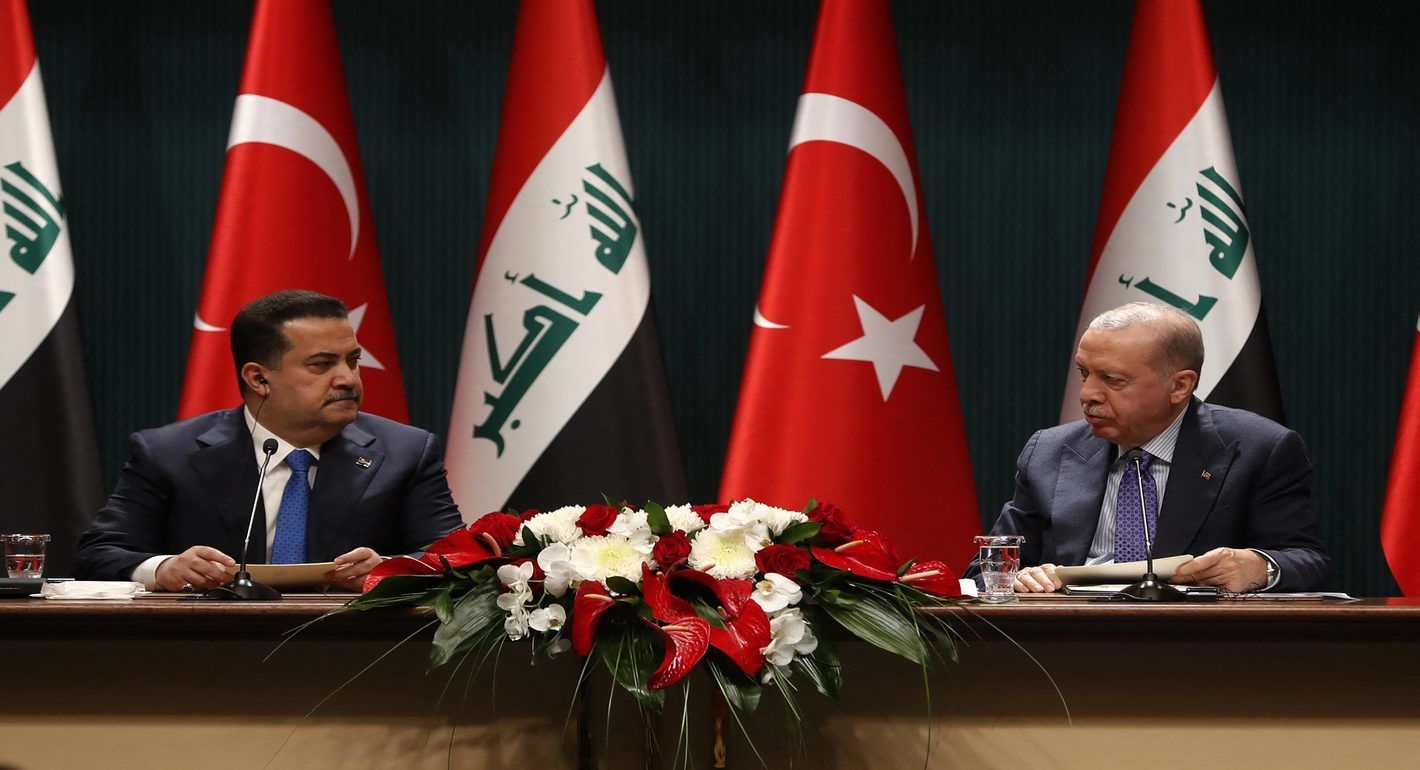
Iraq’s foreign policy is being shaped by its own internal battles—fractured elites, competing militias, and a state struggling to speak with one voice. The article asks: How do these divisions affect Iraq’s ability to balance between the U.S. and Iran? Can Baghdad use its “good neighbor” approach to reduce regional tensions? And what will it take for Iraq to turn regional investments into real stability at home? It explores potential solutions, including strengthening state institutions, curbing rogue militias, improving governance, and using regional partnerships to address core economic and security weaknesses so Iraq can finally build a unified and sustainable foreign policy.
Mike Fleet

How can Saudi Arabia turn its booming e-commerce sector into a real engine of economic empowerment for women amid persistent gaps in capital access, digital training, and workplace inclusion? This piece explores the policy fixes, from data-center integration to gender-responsive regulation, that could unlock women’s full potential in the kingdom’s digital economy.
Hannan Hussain
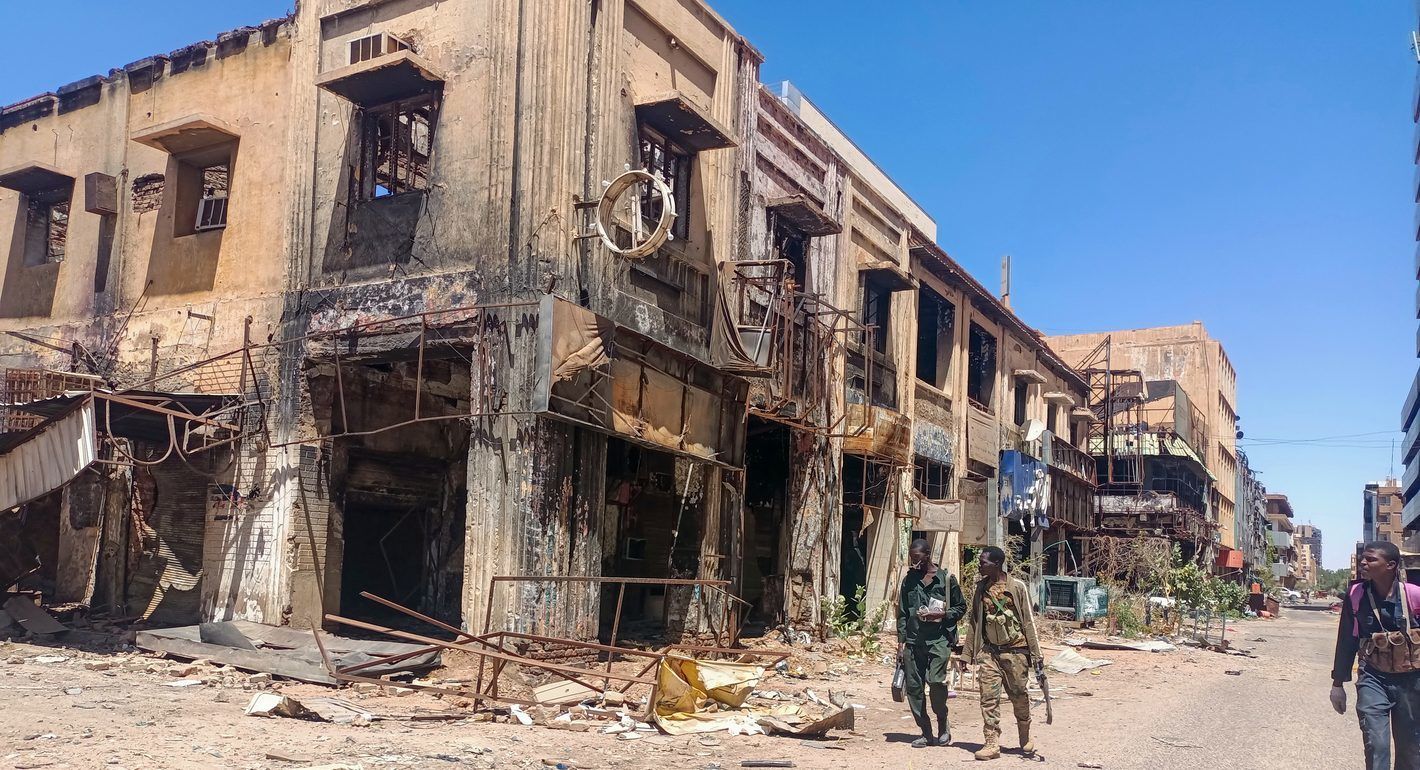
Hate speech has spread across Sudan and become a key factor in worsening the war between the army and the Rapid Support Forces. The article provides expert analysis and historical background to show how hateful rhetoric has fueled violence, justified atrocities, and weakened national unity, while also suggesting ways to counter it through justice, education, and promoting a culture of peace.
Samar Sulaiman

The August 2025 government decision to restrict weapons to the Lebanese state, starting with Palestinian arms in the camps, marked a major test of Lebanon’s ability to turn a long-standing slogan into practical policy. Yet the experiment quickly exposed political hesitation, social gaps, and factional divisions, raising the question of whether it can become a model for addressing more sensitive files such as Hezbollah’s weapons.
Souhayb Jawhar