

Paper
Lora Saalman
{
  "authors": [
    "Lora Saalman"
  ],
  "type": "legacyinthemedia",
  "centerAffiliationAll": "",
  "centers": [
    "Carnegie Endowment for International Peace",
    "Carnegie China"
  ],
  "collections": [],
  "englishNewsletterAll": "",
  "nonEnglishNewsletterAll": "",
  "primaryCenter": "Carnegie Endowment for International Peace",
  "programAffiliation": "",
  "programs": [],
  "projects": [],
  "regions": [
    "North America",
    "United States",
    "East Asia",
    "China"
  ],
  "topics": [
    "Nuclear Policy",
    "Security",
    "Arms Control"
  ]
}
Source: Getty
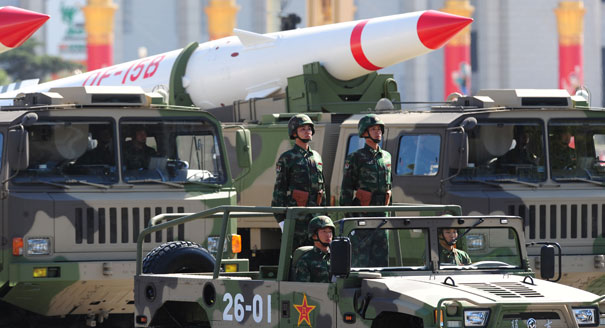
While interdependence might bring China to the negotiation table, its presence does not guarantee meaningful engagement, much less nuclear reductions.
Source: Strategic Stability: Contending Interpretations
In China, everything from its “peaceful rise” to “harmonious development” has been predicated on economic incentives to maintain a stable environment. While China’s rapid economic growth would enable it to greatly expand its nuclear arsenal, this priority has conversely compelled it to emphasize economic growth and stability over arms racing. As part of this logic, interdependence is a driver of stability. While the concept is not new, its linkage to strategic stability is.Interdependence fits China’s construct for relations with the rest of the world, based on intertwined interests and economic incentives. Yet, there exists a parallel discourse on comprehensive national power (CNP) in China. The latter predates the former and posits that China’s lack of comparative political, economic, and military power constrains its participation in strategic stability talks or nuclear reduction negotiations. When these two discourses intersect, however, Chinese claims of inadequate CNP are increasingly difficult to justify.
This trend has far-reaching implications for Sino-U.S. strategic relations. While interdependence might bring China to the negotiation table, its presence does not guarantee meaningful engagement, much less nuclear reductions. So while much ink has been spilled on whether or not China will sprint to parity, not enough has been devoted to whether it has adequate incentives to walk towards zero. This essay shows that Chinese experts are likely to find the opportunity costs of disarmament to be greater than the benefits.
This article was originally published in Strategic Stability: Contending Interpretations

Former Nonresident Associate, Nuclear Policy Program
Saalman was a nonresident associate in the Nuclear Policy Program at the Carnegie Endowment for International Peace. Her research focuses on China’s nuclear and strategic policies toward India, Russia, and arms control.
Recent Work
Lora Saalman
Lora Saalman
Carnegie does not take institutional positions on public policy issues; the views represented herein are those of the author(s) and do not necessarily reflect the views of Carnegie, its staff, or its trustees.

Lessons from other backsliding democracies show that mass mobilization needs to feed into an electoral strategy.

Saskia Brechenmacher, Shreya Joshi

The wars in Ukraine and the Middle East are existential threats to Europe as a peace project. Leaders and citizens alike must reaffirm their solidarity to face up to today’s multifaceted challenges.

Marc Pierini

The United States ignores the region’s lived experience—and the tough political and social trade-offs the war has produced—at its peril.

Evan A. Feigenbaum

The GDP measure is an attempt to measure value creation in an economy. This measure, however, can vary greatly between economies that have disciplinary mechanisms that force them to recognize investment losses quickly and economies that don’t, and can postpone this recognition for many years.

Michael Pettis

Ukraine’s asymmetric approach has rendered Russia’s Black Sea Fleet functionally useless. But a long-term commitment will be needed to maintain this balance of power.
Alina Frolova, Stepan Yakymiak